April 11, 2026
Corporate Video Example: What Actually Works
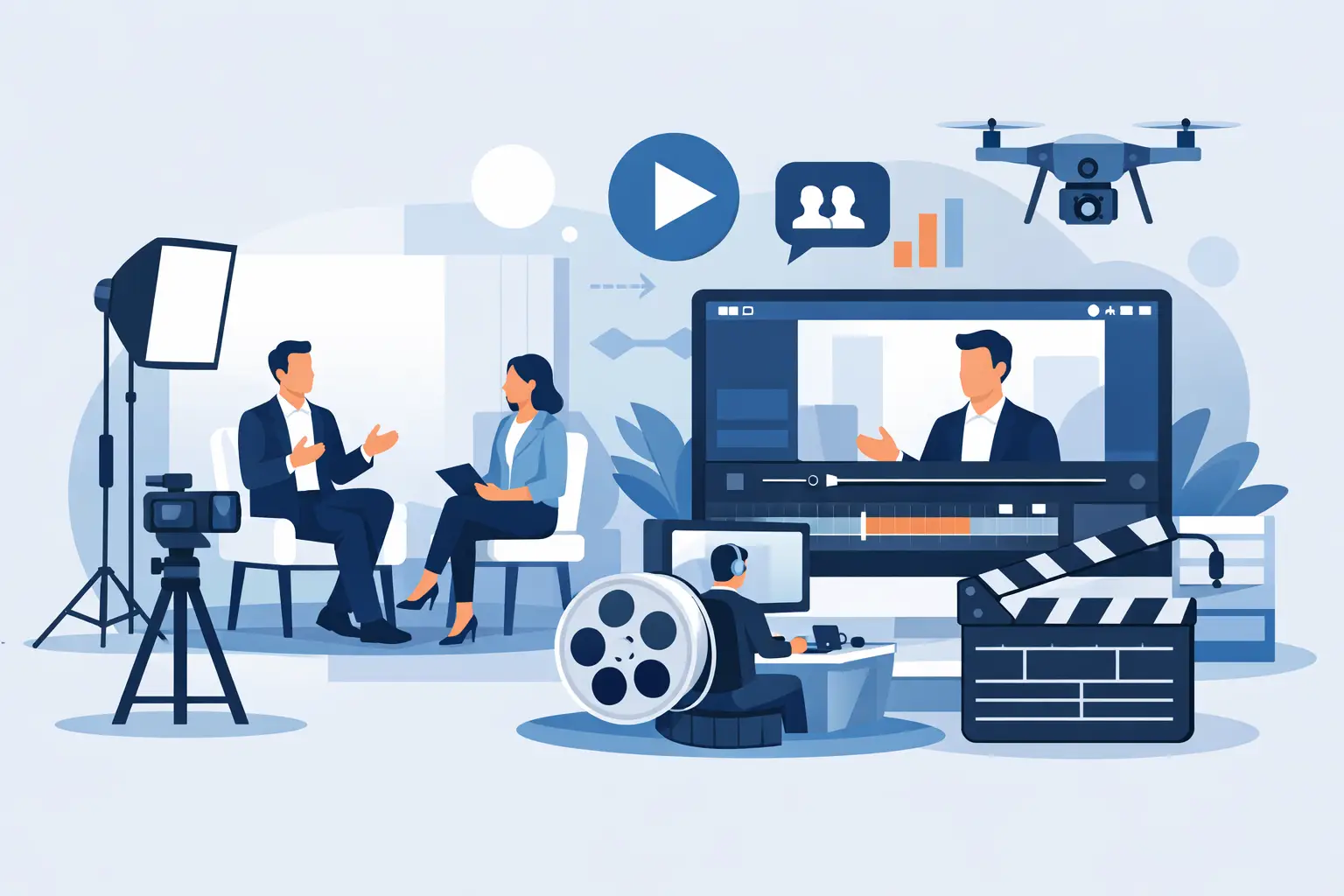
Before we jump in, you should know that Let People See is here for all your video production needs. We're based in Greenville, SC and travel all over the country. Explore around our site to find out more. For now, let's dive in to the details!
Let People See has tons of examples to review, feel free to dig around the website. This article will give you an idea of the different types of content you can create. Let's dive in!
A marketing team asks for a brand video. Sales wants something shorter for outreach. HR needs recruiting content. Leadership wants the company to look more established by the next board meeting. That is usually where the search for a strong corporate video example begins - not with creative curiosity, but with a business need.
The problem is that many examples look polished without being especially useful. They may have attractive footage, clean motion graphics, and a confident voiceover, yet still fail to support a clear business objective. For companies investing real budget and stakeholder attention, the better question is not simply what looks good. It is what works, for whom, and in what context.
What a good corporate video example should show
A useful corporate video example does three things at once. It reflects the brand accurately, it respects the audience's time, and it supports a defined business outcome. If one of those pieces is missing, the video may still be watchable, but it will be harder to justify as a business asset.
For a corporate audience, clarity matters more than creative excess. Decision-makers are not looking for video that feels cinematic for its own sake. They want communication that strengthens credibility, explains value, and helps move a prospect, employee, or partner toward action. That action may be a sales conversation, a recruiting inquiry, greater internal alignment, or stronger event follow-through.
This is where many examples fall short. They present the company as broad, ambitious, and innovative, but say very little that is memorable or specific. A stronger example shows what the company does, who it serves, and why that matters in practical terms. It gives the viewer enough substance to trust what they are seeing.
The most common types of corporate video examples
Not every corporate video is trying to do the same job, so it helps to evaluate examples by category rather than style alone.
Brand overview videos
This is the format many people picture first. It is a concise, high-level video that introduces the company, its capabilities, and its market position. Done well, it becomes a versatile asset for websites, presentations, sales meetings, and trade show environments.
A good brand overview video feels focused. It does not attempt to explain every service line, every business unit, and every internal priority. Instead, it establishes the company clearly and gives viewers a reason to keep the conversation going. The trade-off is that broad messaging can become generic if the script is too safe.
Manufacturing and operations videos
For industrial, technical, and manufacturing businesses, this category often carries more weight than a traditional brand piece. Prospects, partners, and recruits want to see the real environment, the process, the people, and the standards.
A strong example in this space balances professionalism with authenticity. It shows operational capability without turning into a sterile facility tour. It highlights safety, scale, precision, and process, but it also helps viewers understand what those strengths mean in business terms - quality control, delivery confidence, engineering expertise, or production capacity.
Recruiting and culture videos
These videos are often underestimated. A recruiting video is not just an HR tool. It can shape market perception, support retention, and make the company feel more tangible to candidates who are comparing multiple employers.
The strongest examples avoid stock phrases about being a family or offering great opportunities. They let employees speak in a credible way, supported by visuals that make the workplace feel real. If the message overpromises or feels overly polished, the video may attract attention but weaken trust.
Internal communications videos
Leadership updates, training content, change management messaging, and company announcements all fall into this group. These videos are not meant to impress a public audience. They are meant to reduce confusion and improve alignment.
A good example here is usually simple and disciplined. Production quality still matters because it reflects organizational seriousness, but clarity matters more. If employees finish the video without understanding what changes, what matters, or what is expected next, the content has missed the mark.
Event recap and event marketing videos
For conferences, corporate meetings, launches, and industry events, video can extend value well beyond the event date. A recap video can support future promotion, sponsor visibility, internal reporting, and social distribution.
The best examples capture energy without losing structure. They show attendance, engagement, speakers, branded environments, and meaningful interactions. But they also serve a strategic purpose. Some are meant to help sell next year's event. Others are built to prove ROI to leadership or provide a post-event asset library for marketing.
What separates a strong example from a forgettable one
Most business videos are not judged only by aesthetics. They are judged by whether they make the company look credible and whether they can be used effectively across channels.
The message is built around a purpose
If the purpose is vague, the video usually is too. A solid corporate video starts with a clear job to do. Is it opening doors for sales? Supporting a campaign? Helping candidates picture themselves at the company? Reinforcing trust after a merger or leadership change?
Once that purpose is defined, the creative choices get easier. The script becomes tighter. The interviews become more useful. The edit has a clear point of view. Without that foundation, many videos end up trying to serve five priorities at once and fully serving none of them.
The visuals support proof, not just polish
Strong visuals matter, but in corporate production, they should reinforce evidence. Real facilities, real employees, real process, and real environments usually outperform generic beauty shots. Viewers want to see the operation behind the promise.
That does not mean every frame must feel raw. It means the production should capture the company at its best while still showing something believable. Over-stylized video can create distance, especially in manufacturing, logistics, healthcare, and other sectors where trust depends on operational confidence.
The people on camera feel credible
Executive interviews, employee soundbites, customer comments, and voiceover all shape how the company is perceived. The strongest examples feature people who sound like they know what they are talking about, not people reciting approved language that has been flattened by committee.
This is one reason pre-production matters so much. Good direction helps non-professional speakers come across clearly and confidently. It also helps the final piece feel natural while still staying on brand.
The edit respects business attention spans
A video can be excellent at two minutes and ineffective at four. Corporate viewers are not against longer content, but the length has to earn itself. A homepage overview may need to move quickly. A recruiting piece may benefit from more personality. A leadership message may require more explanation.
The right duration depends on the audience, the platform, and the stage of the conversation. That is why a single master cut is rarely enough. Often the most effective corporate video examples are part of a package that includes shorter versions for campaigns, sales use, recruiting, and event promotion.
How to evaluate any corporate video example before you invest
When teams review examples, they often focus first on style. That is understandable, but it is not the most useful filter.
Start by asking what business role the video appears to play. Then look at how clearly it communicates the company's value, how credible the people and environments feel, and whether the structure would hold attention in a real business setting. If the video is impressive but gives little sense of what the organization actually does, it may not translate into results.
It also helps to look for signs that the production understands corporate realities. Can the content work across departments? Does it seem built for stakeholder review, multi-use distribution, and long-term brand consistency? In B2B environments, those factors matter as much as creative execution.
A production partner should be able to explain why an example was built the way it was. That includes audience, message hierarchy, interview approach, filming choices, and intended usage. If the thinking behind the video is unclear, the result may have been led more by aesthetics than by strategy.
Why the best corporate video example is context-specific
There is no single corporate video example that works for every business. A regional manufacturer, a multi-location service brand, a healthcare organization, and a software company all have different proof points, audiences, and communication pressures.
That is why the strongest work is built around context. The right approach depends on the sales cycle, the level of market awareness, the complexity of the offering, and the internal expectations tied to the project. A video that performs well for investor communications may be the wrong shape for recruiting. A strong trade show loop may not work as a homepage introduction.
For business teams, that is the practical takeaway. Look for examples that show strategic fit, not just visual quality. The video should match the audience, support the objective, and make the company easier to understand and trust.
At Let People See, that business-first standard is what makes video more than a nice asset. It makes it usable. And when a video is built to be used, not just admired, it tends to keep delivering long after launch.
Related Articles
- What Is a Corporate Video Editor?
What is a corporate video editor? Learn what they do, how they support brands, and why strong editing turns footage into business-ready video.
- B2B Brand Storytelling That Actually Works
B2B brand storytelling helps companies earn trust, clarify value, and move buyers. Here's how to make your story useful, credible, and clear.
- Story Brand Examples That Actually Work
See 9 story brand examples that clarify messaging, sharpen positioning, and show how brands turn customer pain points into action.
Ready to begin? Let's schedule a quick Good-Fit Call!
Explore More
Meet the team behind Let People See
What drives our work every day
How we plan, film, and deliver
Real results from real projects
Brand stories, training, recruitment
Conferences, activations, recaps
Facility tours and product films
Mission-driven storytelling
Destination and property videos
Answers to common questions
Where we film across the Southeast