April 25, 2026
Executive Interview Video Production: What Actually Works
Before we jump in, you should know that Let People See is here for all your video production needs. We're based in Greenville, SC and travel all over the country. Explore around our site to find out more. For now, let's dive in to the details!
A CEO sits down for a five-minute interview, and suddenly that one video needs to do six jobs. It has to support the brand, reassure investors, help sales, calm employees, attract candidates, and somehow not feel like scripted corporate wallpaper. That is why executive interview video production is not just a camera setup with nice lighting. It is a business communication exercise with very little room for sloppy choices.
When it is handled well, an executive interview becomes one of the most flexible assets in a company's content library. It can anchor a campaign, strengthen a company profile, add authority to a website, support internal communication, or give a brand a more credible public face. When it is handled poorly, it looks stiff, sounds vague, and makes smart leaders seem uncomfortable on their own message.
What executive interview video production is really for
Most organizations do not commission executive interviews because they want a documentary portrait of leadership. They commission them because they need trust. The audience may be customers, employees, recruits, investors, franchisees, or industry partners, but the goal is usually the same: put a credible face on the company's strategy and values.
That means the production approach has to start with use case, not gear. A founder message for a fundraising initiative needs a different tone than a manufacturing leader speaking about safety, or a healthcare executive discussing growth, or a regional president addressing a merger. Same interview format, different business stakes.
The strongest executive interview videos feel focused because the team behind them has already answered a few unglamorous questions. Who needs to believe this message? What action should follow? Where will the video live? What claims need support from b-roll, graphics, or data? If those decisions are vague, the interview usually ends up vague too.
Why executive interview video production often goes sideways
The most common problem is over-scripting. Companies want precision, which is fair. Nobody wants an executive freelancing through a sensitive topic. But if every sentence is written for legal review instead of spoken by a real person, the final video sounds like it was assembled by committee in a conference room with bad coffee.
The opposite problem is under-preparation. Some teams assume a senior leader can simply sit down and speak off the cuff because they know the business well. Sometimes that works. Often it produces circular answers, filler language, and a lot of footage where someone intelligent says very little.
Then there is the production issue nobody likes to admit: executives are not full-time on-camera talent. They are busy, they may be skeptical, and they usually want this done fast. A good crew understands that the job is not to chase cinematic vanity shots. The job is to create an environment where a leader can deliver a clear message with confidence, efficiency, and enough polish to reflect the brand properly.
The pre-production work that saves the shoot
The quality of an executive interview is usually decided before anyone turns on a light. Pre-production is where the team aligns message, audience, visuals, and approval needs. It is also where you avoid the expensive tradition of realizing key issues during the edit.
A strong prep process starts with a messaging outline, not a word-for-word script. That outline should identify the primary theme, the supporting points, and the phrases that matter for brand consistency. It gives the executive structure without forcing a memorized delivery. For most business interviews, that balance works better than either total improvisation or rigid scripting.
Question design matters more than many clients expect. Weak questions produce generic answers. Strong questions invite specifics, perspective, and examples. Instead of asking, "Tell us about your company culture," ask, "What does your team do differently that employees notice in the first 90 days?" One gets jargon. The other gets footage you can actually use.
Logistics matter too. Wardrobe guidance, location selection, teleprompter decisions, makeup, room acoustics, and schedule planning all affect the final result. If a senior executive has 22 minutes available between meetings, the production team should not be figuring out audio challenges in real time.
The interview setup should support the message
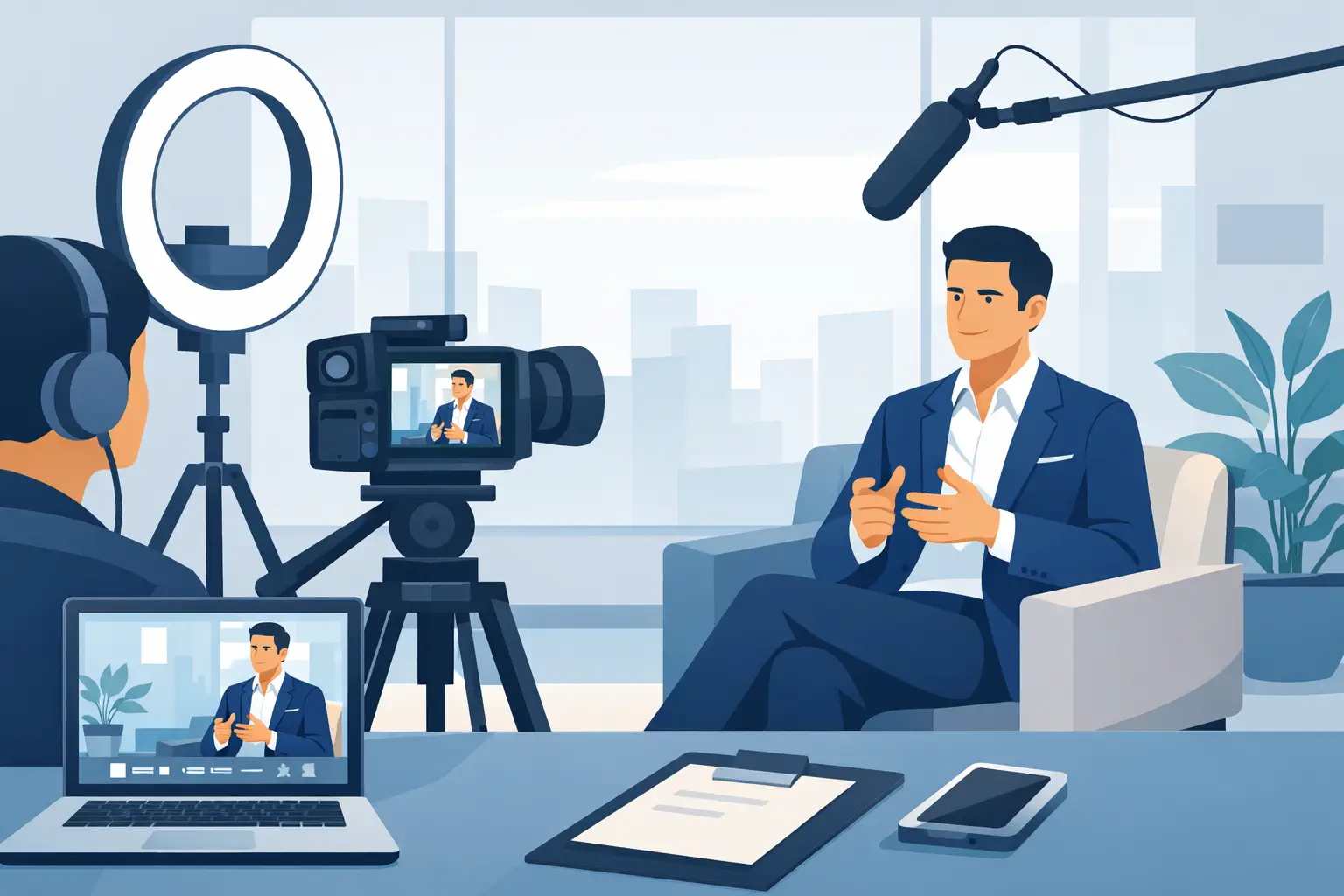
A good executive interview does not need to look flashy. It needs to look intentional. Background, camera angle, lens choice, lighting, and framing should reinforce the tone of the message and the status of the speaker without turning the whole thing into a staged PR artifact.
For example, a CEO discussing long-term vision may benefit from a clean, composed office setting or a well-controlled environment tied to the brand. A plant leader speaking about operations may be better framed with manufacturing context in the background, if the location can be controlled for sound and safety. The setting should add credibility, not distraction.
Multi-camera setups can help, especially when time is tight and edits need flexibility. They allow smoother cuts, reduce the visual impact of trimming answers, and add polish without requiring the executive to repeat every sentence. Good audio is non-negotiable. Viewers will forgive a lot before they forgive poor sound.
The interviewer also plays a major role. An experienced producer or director knows how to guide the conversation, manage nerves, redirect rambling answers, and help the subject say the stronger version of what they already mean. That skill is not decorative. It is often the difference between a usable leadership video and an expensive exercise in media training.
What makes an executive interview feel credible on camera
Credibility is a mix of delivery, specificity, and restraint. If the executive sounds rehearsed, viewers notice. If they sound vague, viewers notice that too. The sweet spot is a confident speaker delivering clear thoughts in natural language, with enough detail to feel grounded in real business activity.
That usually means cutting empty phrases and keeping the message close to lived experience. A leader talking about innovation will sound far more convincing if they reference a recent shift in process, customer need, or hiring strategy rather than repeating broad claims about excellence. Corporate audiences are not allergic to polished messaging. They are allergic to messaging that says nothing.
Visual support matters here. B-roll can keep the pace moving and give claims some proof. If an executive talks about quality, show the process. If they mention customer support, show the team in action. If they discuss growth, show the operational scale. Talking heads alone can work, but they rarely work as hard as they should.
Editing for business outcomes, not vanity
A common mistake in executive interview video production is building one long hero cut and calling it done. In practice, most organizations need more than that. They need modular assets that serve different channels and different viewers.
The full interview may support a website, an investor page, or an internal meeting. Shorter cuts may be better for recruitment, social campaigns, sales follow-up, or event screens. Pull quotes can become standalone clips. Stills from the shoot can support other marketing materials. A well-planned production session should create an asset package, not a single file everyone politely praises and rarely uses.
Editing should also respect the audience's tolerance for fluff. Most executive videos improve when they get tighter. The point is not to preserve every decent sentence. The point is to deliver the clearest version of the message with enough pace to hold attention.
This is where an experienced corporate production partner earns their keep. They know when to leave in a pause because it feels human, when to cut around a stumble, when to overlay visuals, and when a line sounds polished but not believable. That judgment is hard to fake.
When the investment pays off
Executive interviews can be highly efficient content when they are planned with purpose. One shoot can generate material for brand marketing, internal communications, recruitment, PR support, event content, and sales enablement. For organizations trying to get more value from fewer production days, that matters.
They are especially effective when the business needs authority, clarity, or reassurance from leadership. During change, growth, expansion, hiring pushes, major announcements, or category positioning efforts, hearing directly from an executive can carry more weight than a page of copy ever will.
That said, not every message belongs on camera. Some topics are too technical, too sensitive, or too underdeveloped for an executive interview to carry them well. Sometimes a voiceover-driven brand film, customer story, or product-focused piece is the better format. Good strategy includes knowing when not to put the leader in the chair.
For companies that do need it, the standard should be simple. The video should sound like the leader, look like the brand, and serve a real business purpose. If it only checks one or two of those boxes, it is not ready yet.
A strong executive interview does not need theatrics. It needs clarity, preparation, and a production team that understands business communication well enough to make leadership look credible without making them look manufactured. That balance is rare, which is exactly why it is worth getting right.
Related Articles
- 9 Manufacturing Recruitment Video Examples That Work
See 9 manufacturing recruitment video examples and what makes them work, from plant tours to employee stories that help attract better-fit hires.
- Video Production in Greenville SC That Works
Video production in Greenville, SC should do more than look good. Learn what business video needs to deliver, from strategy and crews to final usage.
- Video Making Content Ideas for Brands That Actually Work
15 video making content ideas for brands that support sales, recruiting, events, and trust-building without wasting budget or strategy.
Ready to begin? Let's schedule a quick Good-Fit Call!
Explore More
Meet the team behind Let People See
What drives our work every day
How we plan, film, and deliver
Real results from real projects
Brand stories, training, recruitment
Conferences, activations, recaps
Facility tours and product films
Mission-driven storytelling
Destination and property videos
Answers to common questions
Where we film across the Southeast