April 30, 2026
A Manufacturing Training Video Guide for Real Operations
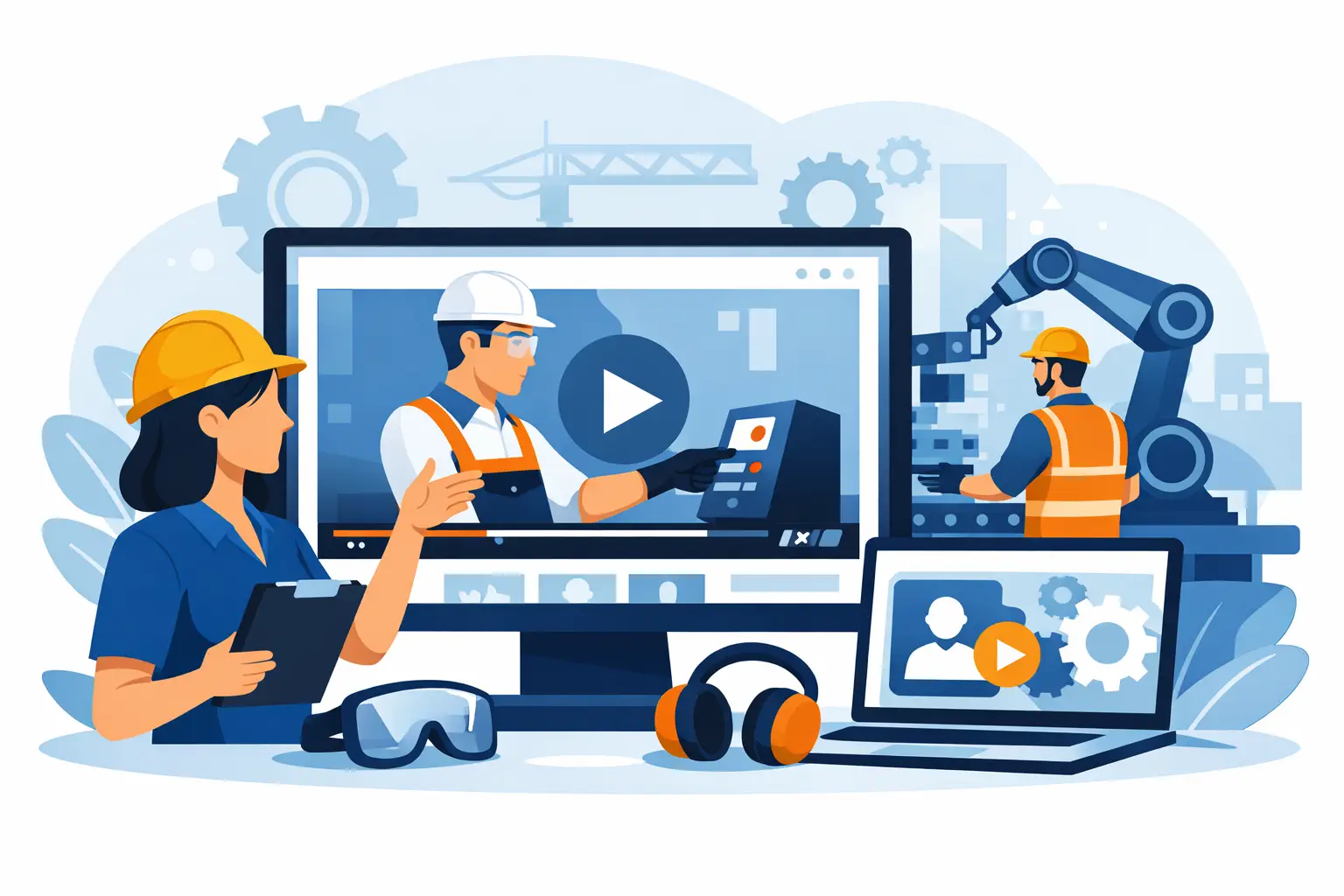
Before we jump in, you should know that Let People See is here for all your video production needs. We're based in Greenville, SC and travel all over the country. Explore around our site to find out more. For now, let's dive in to the details!
The fastest way to lose credibility with a new hire is to hand them a binder, point at a machine, and say, "You’ll pick it up." On a manufacturing floor, that approach is expensive. This manufacturing training video guide is built for companies that need training content to reduce ramp-up time, improve consistency, and support safety without turning production into a classroom.
Training video is not a magic fix. A bad video can waste just as much time as a bad orientation manual. But when the content is planned around real job tasks, real risks, and real operating conditions, it becomes one of the most practical assets a manufacturing company can produce.
What a manufacturing training video guide should actually solve
Most manufacturing teams do not need more content. They need fewer repeated explanations, fewer avoidable errors, and less variation in how critical processes are taught. That is where video earns its place.
A solid training video helps standardize instruction across shifts, plants, supervisors, and onboarding cycles. It gives operations leaders a repeatable way to show how a process is performed, why the standard matters, and what happens when it is skipped. For HR and communications teams, it also reduces the chaos that comes from tribal knowledge living in one veteran operator’s head.
That said, not every topic belongs in video. If a procedure changes weekly, a printed checklist may be easier to maintain. If a task is highly nuanced and depends on live coaching, video should support the trainer, not replace them. The goal is not to film everything with moving parts. The goal is to capture the training moments where consistency has measurable value.
Start with business outcomes, not camera angles
Before anyone talks about scripts, equipment, or shot lists, decide what success looks like. Most manufacturing training videos fall into one of a few categories: onboarding, safety, SOP instruction, maintenance procedures, quality control, equipment operation, or culture and compliance.
Each category has a different standard for success. A safety video should improve recall and reduce risky behavior. An SOP video should make the correct process easy to follow. An onboarding video should shorten the time it takes for a new employee to become productive without compromising safety or quality.
This seems obvious, but it gets missed all the time. Teams approve a video because training feels like a good use case, then end up with a polished piece that says a lot without teaching much. Nice lighting cannot rescue vague objectives. If the outcome is unclear, the edit will be too.
The best manufacturing training videos are built around tasks
People learn manufacturing work in sequences. They do not need broad motivational language when they are trying to remember lockout steps, torque specs, sanitation procedures, or material handling rules. They need to see the task, hear the standard, and understand the consequence of getting it wrong.
That is why strong training videos are structured around actual actions. Show the setup. Show the correct posture, controls, hand placement, and inspection points. Call out the common mistakes. Show what acceptable output looks like and, when useful, what unacceptable output looks like.
For decision-makers, this matters because task-based video is easier to use and easier to update. A six-minute module on startup inspection is more useful than a 25-minute all-purpose training video nobody wants to rewatch. Short, focused videos also fit better into shift schedules and LMS platforms.
Pre-production is where the money is saved
If you want training videos to work in a manufacturing environment, most of the important decisions happen before filming starts. That means identifying subject matter experts, reviewing current SOPs, confirming safety rules, and walking the floor to understand noise, lighting, line movement, and access constraints.
This is also where you decide who the video is for. A new machine operator needs different language than a maintenance technician or a plant visitor. A video for bilingual onboarding may need a different narration strategy than a supervisor refresher. One audience, one objective, one operational context. Keep it clean.
It is worth being blunt here: if your internal process is sloppy, video will expose it. Filming often reveals that different supervisors teach the same task differently, or that the documented SOP and the actual floor practice are not aligned. That is not a production problem. That is useful information. Better to catch it before rollout than after a safety incident or quality drift.
Production on the floor needs more than a camera crew
Manufacturing video production has its own rules. You are filming in live environments with PPE requirements, equipment hazards, variable sound conditions, and often limited windows for access. That is why floor experience matters.
A crew needs to move efficiently, respect plant protocols, and know how to capture detail without disrupting operations. Sometimes that means staging certain shots during downtime. Sometimes it means filming the real process while building in additional close-ups later. Sometimes it means using multiple camera angles so one task can be shown clearly without asking operators to repeat a process ten times for the camera.
Audio deserves special attention. If your floor is loud, relying only on live dialogue is a gamble. Voiceover, on-screen text, and carefully planned demonstrations usually create better training clarity than hoping a noisy environment will somehow sound instructional in post.
Visual clarity matters just as much. If the viewer cannot clearly see the valve position, gauge reading, alignment mark, or PPE step, the video is not doing its job. Training video is not brand film. It should still look professional, but utility comes first.
A good manufacturing training video guide includes governance
This is the part companies tend to skip, and then regret later. Training videos need owners. Someone has to know when a process changes, when a machine is replaced, when a safety update affects the content, and when an old video should be retired.
Without governance, useful training assets quietly become liabilities. A video that shows outdated PPE or an old workstation setup can create confusion fast. That does not mean video is high-maintenance. It means it needs a review schedule and a clear internal owner, usually in operations, safety, HR, or training.
The easiest way to keep a library usable is to build it in modules. Short videos are easier to replace than long ones. If one piece of equipment changes, you can update the relevant segment instead of redoing the entire series.
Where manufacturing training video delivers the most value
The biggest gains usually show up in four places: onboarding speed, process consistency, safety reinforcement, and supervisor efficiency. New hires get a clearer starting point. Experienced staff spend less time repeating the same basic instruction. Training becomes more standardized across teams. And leadership gets a more defensible process for how people are taught.
There are softer benefits too. Well-produced training content signals that the company takes operations seriously. For recruiting and retention, that matters. Nobody expects Hollywood on the plant floor, but employees do notice when training feels organized versus improvised.
For manufacturers in competitive labor markets, including places like Greenville, SC, that can make a real difference. Better training does not solve hiring by itself, but it does improve the experience people have once they walk in the door.
Common mistakes that make training videos less useful
The first mistake is trying to make one video serve everyone. The second is overloading a single piece with too much information. The third is treating production quality as the main goal instead of training clarity.
Another frequent problem is scripting from management language instead of operator reality. If the wording sounds polished but does not match how work is actually done, viewers tune out fast. The best scripts are usually shaped with direct input from the people who perform the task every day.
There is also a temptation to use training video as a substitute for real instruction. That rarely works. Video is strongest when it supports hands-on training, documentation, and supervisor follow-up. Think of it as a force multiplier, not a stand-in for leadership.
Choosing the right production partner
If you are investing in a manufacturing training video guide and turning it into a real content initiative, choose a partner that understands both production and plant reality. You do not need a team that treats your facility like a movie set. You need one that can translate operational knowledge into clear visual instruction without slowing your business down.
That means asking practical questions. Have they filmed in active manufacturing environments? Can they work within safety protocols? Do they know how to structure content for internal communication, not just external marketing? Can they help you organize the material so the final deliverables are actually usable by HR, operations, and supervisors?
A dependable partner will push for clarity early, not just show up with cameras. That is usually the difference between a video that gets watched once and a training asset that keeps paying for itself.
If your training still depends on whoever happens to be available on first shift, the problem is not effort. It is format. The right video strategy turns repeated explanations into repeatable instruction, and that is where training starts pulling its weight.
Related Articles
- Customer Testimonial Video Production That Works
Customer testimonial video production builds trust, shortens sales cycles, and turns real client stories into marketing assets buyers believe.
- What Brand Storytelling Video Services Actually Do
Brand storytelling video services help businesses build trust, explain value, and create content that supports marketing, sales, hiring, and more.
- Internal Communications Video Strategy That Works
Build an internal communications video strategy that improves clarity, trust, and engagement across teams with content employees will watch.
Ready to begin? Let's schedule a quick Good-Fit Call!
Explore More
Meet the team behind Let People See
What drives our work every day
How we plan, film, and deliver
Real results from real projects
Brand stories, training, recruitment
Conferences, activations, recaps
Facility tours and product films
Mission-driven storytelling
Destination and property videos
Answers to common questions
Where we film across the Southeast